Blog
Sleep deprivation: the motor, cognitive and visual impairment and how nootropics can (and cannot) help.

Key Points
• The effect of sleep deprivation is rapidly to impair vigilant attention and delay of reaction time, usually measured by the Psychomotor Vigilance Test (PVT) and closely related to safety in the real world (e.g. driving). Thus, even after 1 night of being awake there is a significant increase in lane departures and ‘near crash’ events.
• Visual performance is impaired in two main ways. (1) impairment of higher order visual processing (particularly motion processing and visual attention) and oculomotor control (saccadic movements and smooth pursuit); (2) impairment of function to the ocular surface resulting in dry eye that blunt vision. Effects on early visual acuity / contrast can be slight or erratic.
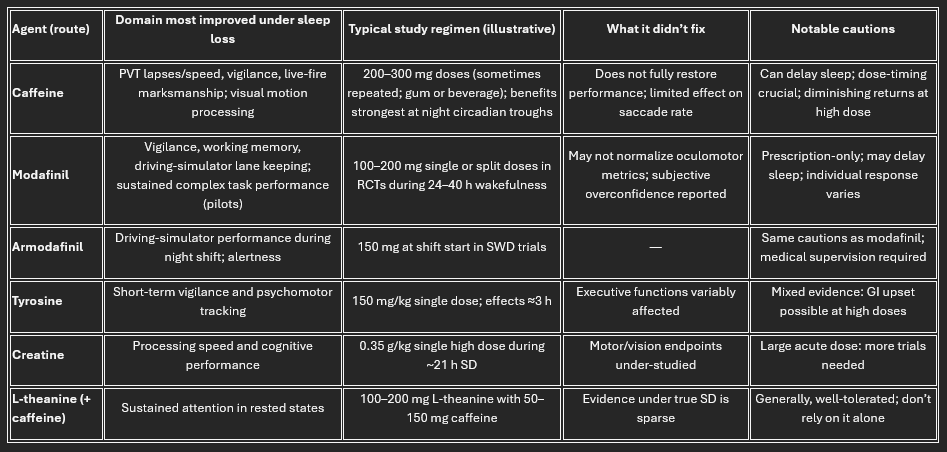
• Caffeine has a reliable effect on relieving lapses of attention, reaction times and certain, motor tasks (for example marksmanship) in sleep deprivation. Internally caffeine normalises some visual performance parameters in motion visual processing but does not completely restore performance. Time and the dose taken are relevant.
• Modafinil/armodafinil (wake promoting prescription drugs) will also relieve cognitive impairment and driving stimulus impairment in sleep deprivation. The effects may last longer than the effects of caffeine but may produce inflation of confidence and may delay sleep onset. These drugs should only be taken under medical supervision.
• Further contenders: tyrosine (an amino acid catecholamine precursor) shows short term beneficial effect on vigilance and psychomotor tests. Creatine (0.35 g/kg + single dose) has recently been shown to enhance cognitive speed in sleep deprivation. The work on L theanine (usually together with caffeine) is supportive of improvement in attention in rested persons but is scanty under conditions of true sleep deprivation.
1) Performance Losses Due to Sleep Deprivation
- Vigilance and Motor Skills
The Psychomotor Vigilance Test (PVT) has been found to be an effective measure of sleep deprivation due to its sensitivity to both acute and chronic sleep deprivation and countermeasures such as naps and caffeine. The level of decrement seen in the PVT is predictive of failures in operational tasks.
- Vision and Eye Movements
Sleep deprivation has been shown to slow down and degrade both saccadic and smooth pursuits which impairs eye-hand or eye-body coordination. Higher order visual processes (i.e. motion perception) are also degraded by sleep deprivation.
- Ocular Surface
Even after only 24 hours of sleep deprivation, total sleep loss increases tear hyperosmolarity, decreases tear break-up time and decreases tear secretion, all of these changes may cause blurred vision and increased eye irritation.
Overall, sleep deprivation adds to a three-pronged burden (mental + oculomotor + ocular surface) which will increase the likelihood of making errors while performing any type of visuomotor task (driving, surgery, industrial operation).
2) Nootropics as countermeasures: what the best evidence shows
The purpose of this study is to evaluate whether certain “nootropic” substances may help to prevent or mitigate the negative effects of prolonged periods without sleep. The researchers found that none of the substances tested completely restored brain function after a period of sleeplessness. However, they did find that many of these substances could help to minimize impairments for a short period.
Researchers evaluated four nootropic substances: Caffeine, Modafinil, Tyrosine, and Creatine Monohydrate.
- Caffeine
The most studied substance tested by the researchers was caffeine. They conducted numerous studies using different methods to test caffeine’s ability to restore cognitive function and physical motor skills after sleepless nights. Their results suggest that caffeine significantly improves reaction time, accuracy and response speed, logical reasoning, and shooting accuracy in situations where participants have been up for long periods of time (up to 72 hours). Additionally, their results indicate that caffeine can eliminate the impairment caused by sleep deprivation on vision processing.
However, caffeine will lose its effectiveness in a few hours and can interfere with sleep if consumed too close to bedtime.
- Modafinil/Armodafinil
Modafinil and armodafinil are prescription medications used to treat excessive daytime sleepiness associated with narcolepsy, obstructive sleep apnoea and shift work sleep disorder. Researchers evaluated the effectiveness of these medications in improving the cognitive and motor abilities of people who have been sleep-deprived. Results from their research indicate that both medications improve aspects of vigilance, working memory, and driving simulator lane-keeping performance. The effects of both medications last longer than those of caffeine, however the researchers warn that use of either medication should only occur under the guidance of a physician and subject to any applicable workplace policies.
- Tyrosine
Tyrosine is an amino acid that serves as a precursor to catecholamines, which are chemicals that regulate arousal and focus. Some of the earliest studies of tyrosine supplementation were conducted in military settings and showed that short-term (three hour) improvements in vigilance and psychomotor tracking occurred in sleep-deprived subjects. While there is evidence suggesting that tyrosine has potential as a tool for managing sleep deprivation, the results are inconsistent, and the magnitude of improvement is variable across individuals.
- Creatine Monohydrate
Creatine monohydrate is an energy buffer commonly used in athletic training programs. Researchers recently evaluated creatine monohydrate in relation to cognitive function during sleep deprivation. One recent study showed that high-dose creatine monohydrate (approximately 24 grams) resulted in significant improvements in processing speed and cognitive performance during approximately 21 hours of sleep deprivation. However, the high dose required to achieve this effect is much larger than the typical daily intake of creatine monohydrate. There are also concerns regarding gastrointestinal side effects.
- L-Theanine
L-theanine is an amino acid found in green tea that is often combined with caffeine. Research indicates that L-theanine combined with caffeine can improve sustained attention and decrease mind-wandering in rested volunteers. However, due to the lack of research evaluating L-theanine’s effects on sleep-deprived subjects, researchers advise caution before recommending L-theanine for preventing or treating sleep deprivation.
3.) What sleep loss affects in vision processing and what doesn’t
• Motion processing & pursuit /saccades. The lack of sleep affects how fast/much things are moving (direction/speed noise) and how well we track them (smooth pursuit); caffeinated coffee at a small dose will correct the motion processing deficit and support pursuit but not speed up the increasing rate of saccadic movements as you stay awake longer.
• Early visual processing. Research has shown that early processing is somewhat spared; problems generally come from paying attention or processing information centrally. This explains why a “vigilance booster” (caffeine/modafinil) improves performance without improving basic acuity.
• Contrast sensitivity and colour. There have been mixed results; one 60-hour study using naval officers found no clinically significant changes in achromatic and chromatic contrast sensitivity; however, research also indicates that higher level visual attention degrades. Do not rely on contrast/colour testing to identify visual impairments caused by sleep deprivation.
• Ocular surface dryness. One-night awake decreases tear production (increases hyperosmolarity, break-up time, and decreases secretion). As a result, it causes blurred vision and irritation; nootropics will not fix this. To prevent these practical methods, include frequent blinking, humidified air and artificial tears if recommended by a licensed eye care provider.
4) Prioritize safety and evidence informed reductions in risk (where exceptional circumstances dictate) Prefer sleep (or napping) whenever possible.
PVT based fatigue modelling and field programmes have predominantly emphasised planned sleep and judiciously timed caffeine, rather than sheer caffeine consumption alone. OUP Academic If stimulant use is essential:
Caffeine: Smaller, well-timed doses (e.g. 100-200 mg, repeated), during circadian low times, are more effective and less pernicious for subsequent sleep than a single delayed high dose. Avoid dosing in close proximity to intended sleep.
Modafinil/armodafinil: Prescription only, only to be considered under the scrutiny of a medical practitioner. Beware of potential subsequent sleep effects or mis calibrated self-confidence. This is not a licence to operate safety critical tasks whilst sleep deprived.
Other stimulants (Tyrosine/creatine): Possibly offer short term cognitive enhancement but the evidence for motor or vision specific rescue is in its infancy. Trials should be undertaken in a low-risk environment before any form of operational use.
Visual tasks: Max out on lighting, micro breaks and anti-dryness strategies; remember that central attention, not simply optical propriety, limits performance when sleep deprived.
DO NOT drive or perform hazardous tasks when significantly sleep deprived (even if after a stimulant, you “feel fine”). Impairment remains and the risk of adverse events is considerably elevated.
5) Evidence table
6) Ethics, regulations, and recovery
- Stimulants are NOT A SUBSTITUTE FOR SLEEP. Both research models (RCTs) and studies show that while stimulants reduce fatigue, they will not completely remove it, and you will not return to the same level as when you were well-rested. Plan your sleep recovery.
- Many industries (airline, trucking, construction) have restrictions on the use of stimulants due to workplace safety concerns. Prescription stimulants should be used only under the guidance of a physician.
Caffeine in the afternoon and evening hours, as well as many over the counter (OTC) and prescription stimulants may cause a reduction in the quality or quantity of your sleep following consumption. Therefore, it is very important to plan to allow yourself to get a full night’s rest after consuming any type of stimulant.